Why this matters
Term limits set how much consecutive power any one official can hold. Voters capped it at 8 years in 1996. In 2019, a council attempt to loosen that cap was defeated after residents packed a meeting to oppose it. Five years later, a similar measure returned as Measure W — this time drafted with taxpayer funds, substantially financed by sitting council members and their families, and passed after the ballot question and City-funded outreach materials did not disclose that prior service would not count toward the new limit. The provision was disclosed in the City Attorney's impartial analysis published in the voter guide.
Five facts to know
The full timeline
Every entry below is drawn from the public record — council minutes, campaign finance filings, consultant invoices, and correspondence. Tap any entry to expand it. Two labels appear where relevant: Documented marks a claim drawn directly from a primary record (a filing, a letter, an official's own words), and Analysis marks a passage where this record explicitly weighs a fact pattern and states what is, and is not, being alleged.
1996
Voters approve Measure O, adopting two-term (8-year) consecutive limits for City Council members with nearly 80% approval. A mandatory four-year cooling-off period follows before a former member can run again.
Aug. 20, 2019
At a study session, Councilmember Nitesh Patel — who says he requested the item and is “neither in support or opposed” — raises extending consecutive terms from two to three (12 years) and shortening the cooling-off period from four years to two. Councilmember Goedhart, not seeking re-election, moves to direct staff toward a March 2020 ballot measure; it carries 3-0 (Goedhart, Goodman, Steggell), with Kim and Patel abstaining. Mayor Goodman calls it “no nefarious intent.”
Sept. 3, 2019
Residents turn out against Resolution 2019-40, the formal ballot measure. Eleven speak, nearly all opposed — including Robert Carruth, who asks it be tabled permanently, and letters from former Councilmember Steve Hwangbo and resident Steve Maikoski.
Kim now says he doesn't support it; Goedhart says the timing is wrong; Goodman moves to table it indefinitely, Patel seconds, and the council kills it unanimously, 5-0. It never reaches the ballot — until a similar proposal returns as Measure W five years later, with far less pushback and a different result. See June 4, 2024, below.
Feb. 2024
Per Voice of OC's reporting, the push to extend term limits “came back in February from incumbent La Palma City Council members” — city officials said the change was needed to help maintain city leadership because participation in running for public office is low. At a February council meeting, Mayor Marshall Goodman said “something needed to be done” about so many officials running unopposed; he himself ran unopposed in 2016. Voice of OC, "Will La Palma See 20-Year Politicians?"
Apr. 4, 2024
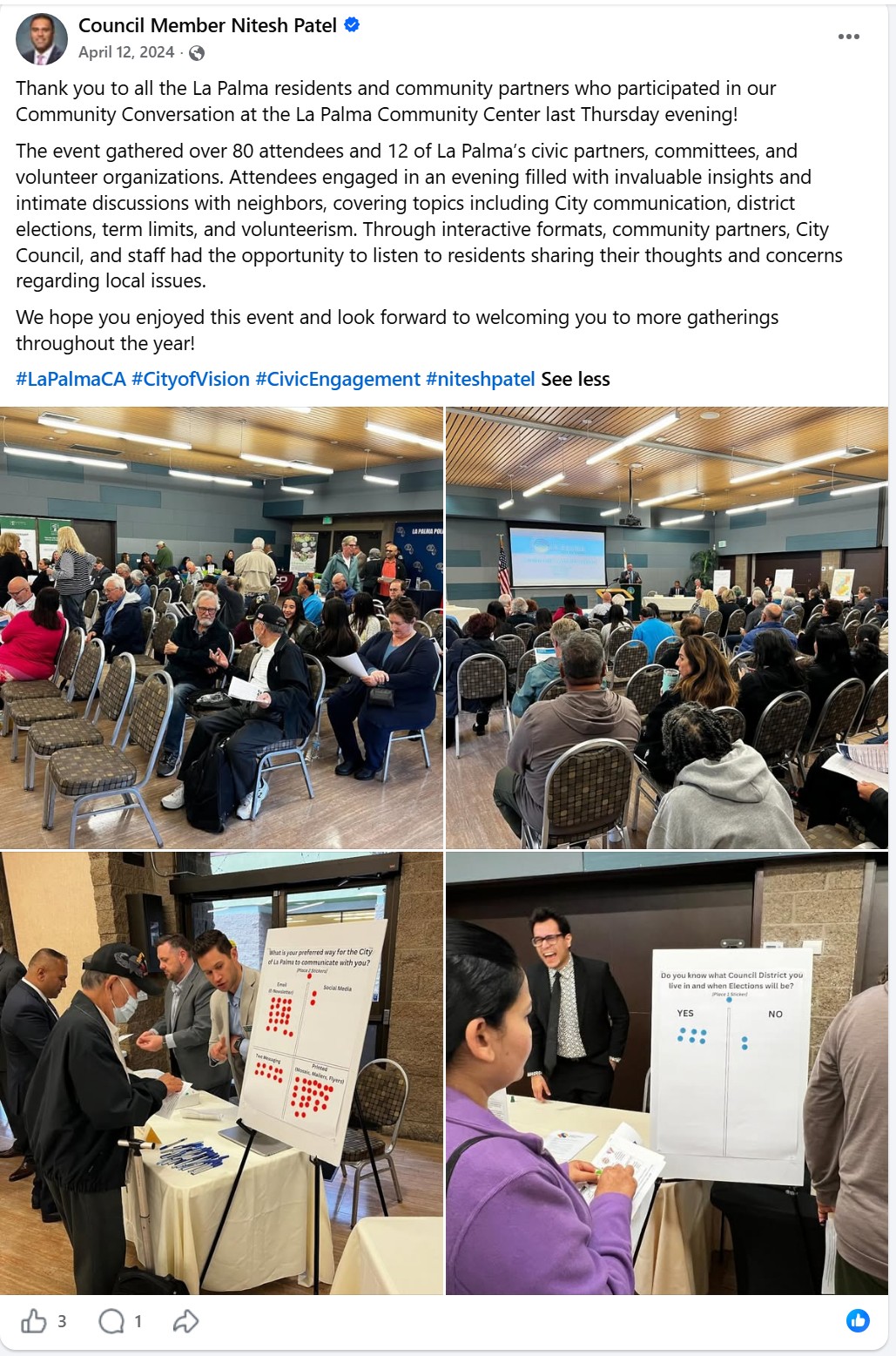
Before drafting any ballot measure, the City tests public opinion at a “Community Conversation” at the La Palma Community Center — over 80 attendees, 12 civic partners. City calendar listing for the event.
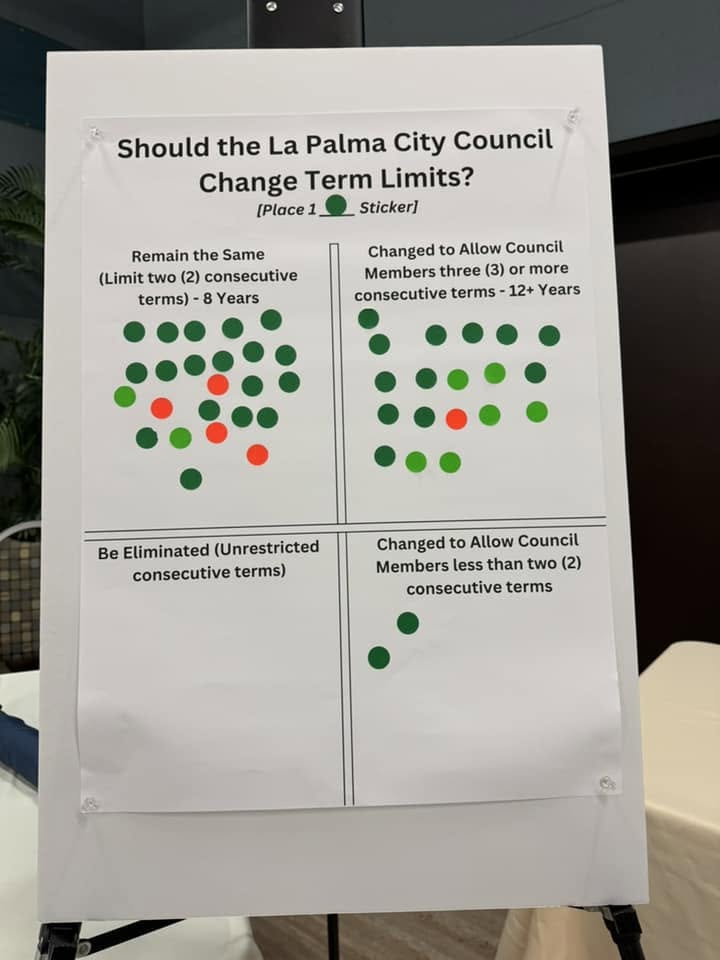
At the term-limits station, sticker votes split 26 to 19 in favor of keeping or lowering the existing limit — a majority against the very change the council would soon send to voters.
A month later the City hires a consultant to draft that measure (below), and the council places it on the ballot June 4 without addressing this feedback. Patel later forms and leads the Yes on W committee.
May 8, 2024
Weeks before any public vote, the City signs a not-to-exceed $20,000 consulting agreement with Tripepi Smith for “Outreach Services on a potential ballot measure to adjust term limits,” with firm president Ryder Todd Smith as project manager. Weekly calls with the City Manager's office begin that month, and Smith's own invoices show him drafting ballot language and the press release announcing the council's resolution. The invoices show City funds were used for ballot-language work before the council's formal June vote. See Leadership for Tripepi Smith's recurrence in the record: interim City Manager Michael Egan's prior work as a director for the firm.
June 4, 2024
The council votes 4-1 (Keo Conklin dissenting) to place Measure W on the ballot, extending term limits from 8 to 12 consecutive years — the same structure floated and killed in 2019. Keo Conklin later says “residents did not call for the term increase.” The measure is branded the “Election Reform and Voter Choice Measure,” language that runs through the consultant's paid materials. Voice of OC, "Will La Palma See 20-Year Politicians?"
The consultant-written, 75-word ballot question leads with benefits — expanded voter choice, “more consistent community leadership,” a broader candidate pool — and never states that it raises the cap to 12 years, or that sitting members' prior terms wouldn't count toward it. The City Attorney's impartial analysis confirms members get “a fresh set of three (3) four-year terms”; Voice of OC calculated the effect: incumbents could serve up to 20 years.
That reset appears in none of the taxpayer-funded materials — not the trilingual FAQ, the utility bill insert, the citywide mailer, or the news release. It surfaced only in the county voter guide's impartial analysis.
How the reset was written in — Measure W's operative text applies the new 12-year cap only to terms “commencing with” the November 5, 2024 election, so a sitting member's already-served 8 years don't count at all. A councilmember finishing an 8-year run in 2024 could be re-elected and serve three more four-year terms on top of it — up to 20 consecutive years — without ever triggering the cooling-off period 1996 required. The ordinance's operative language produces this effect regardless of whether it was drafted with that specific outcome in mind, and it is the one fact City-funded Measure W communications never disclosed.
Sep. 16, 2024
Tripepi Smith invoices $18,091.50 in public funds across five months ($4,893.75 / $7,116.50 / $3,345.00 / $1,368.75 / $1,367.50) for ballot drafting, the citywide mailer, the trilingual FAQ, the utility insert, and social-media monitoring. State law allows neutral ballot education but bars campaign advocacy (Gov. Code § 54964; Vargas v. City of Salinas (2009) 46 Cal.4th 1).
Records the City produced under a public records request include drafts of the ballot's own “Argument in Favor” and “Rebuttal to Argument Against” — formal campaign documents — sitting in the consultant's city files. View the underlying records (PDF)
Oct. 24, 2024
FPPC Forms 460 and 497, available only by public records request, show who actually funded Yes on W.
Documented — required FPPC campaign finance filingNitesh Patel served as Treasurer of the Yes on W committee (FPPC ID #1474110), certifying its filings under penalty of perjury from his own Shirley Drive residence, with his personal Gmail as the committee's contact.
The October 24, 2024 Form 460 reported $24,500 in contributions through October 19, and approximately $22,960 in expenditures. Published reports based on the complete filings — which include contributions reported after October 19 not reflected in the figure above — put the campaign's final receipts at approximately $26,500.
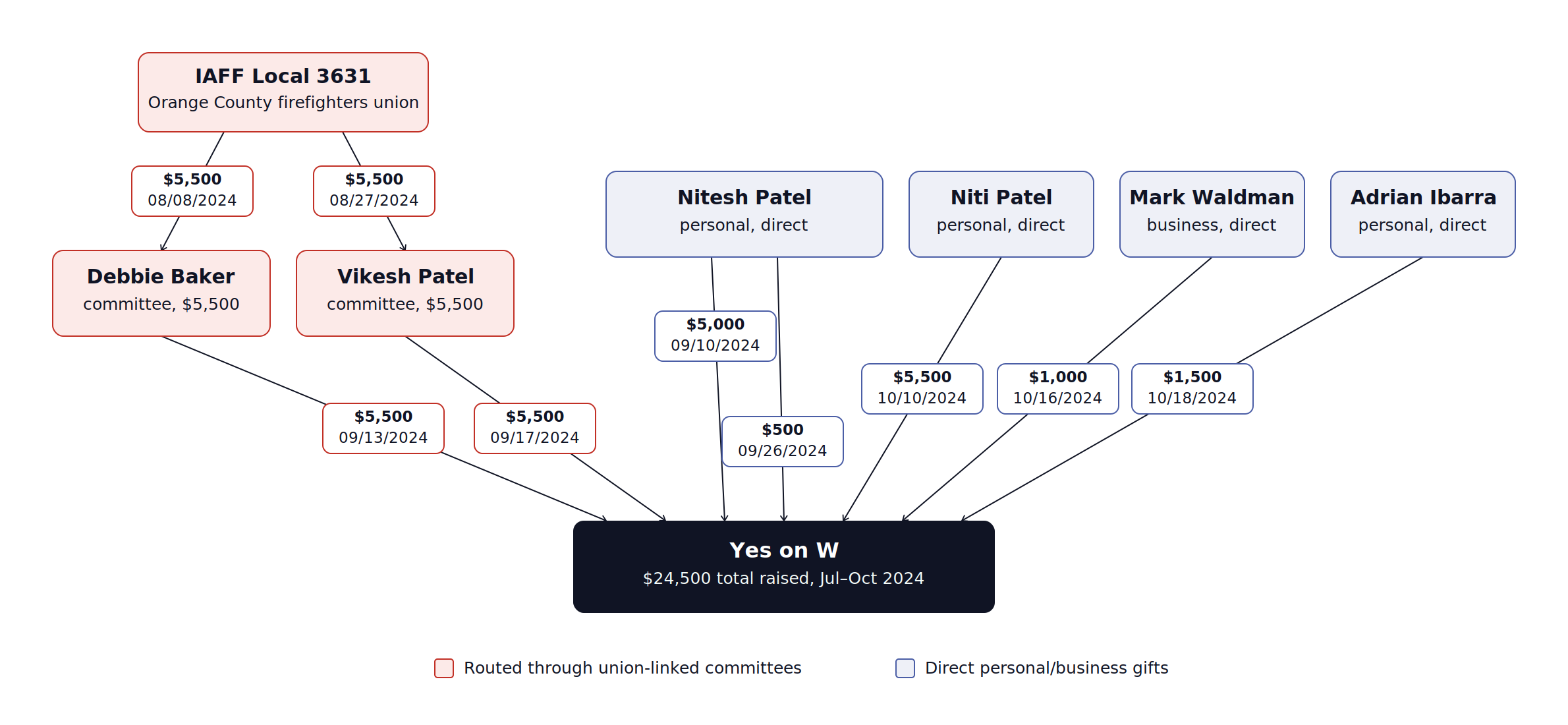
The committee's filings identify several notable contributors: Nitesh Patel ($5,500; employer listed as Devi Construction), Niti Patel ($5,500, from the same Shirley Drive address, tied to Ram Tulsi LLC), Debbie Baker's campaign committee ($5,500), Vikesh Patel's campaign committee ($5,500), Adrian Ibarra ($1,500 — business ties detailed below), and Waldman Tax & Financial Services ($1,000 — Councilmember Mark Waldman's business, matching his own Form 460).
The first pre-election Form 460, covering July 1 through September 21, reported $16,000 in contributions from just three sources: $5,000 from Nitesh Patel and $5,500 each from the campaign committees of Councilmember Debbie Baker and Patel's brother, incoming Councilmember Vikesh Patel.
IAFF 3631 -> Baker & Vikesh Patel
The campaign filings reveal another noteworthy sequence involving the Orange County Professional Firefighters Association, IAFF Local 3631.
Per the committee's Form 497 filings, Local 3631 contributed $5,500 to Debbie Baker's campaign committee on August 8, 2024, and $5,500 to Vikesh Patel's campaign committee on August 27. Those committees subsequently contributed the same amounts to Yes on W — Baker's committee on September 13 and Vikesh Patel's on September 17.
$11,000 originating as firefighter-union contributions to two candidate committees was followed weeks later by $11,000 in contributions from those committees to Yes on W. The available filings document the transactions and their timing; they do not, by themselves, establish that the transfers were coordinated or made pursuant to any agreement with the union.
The relationship is relevant because Nitesh Patel serves on the Orange County Fire Authority Board, which oversees the agency's budget and labor agreements affecting Local 3631 members. Patel was subsequently elected OCFA Vice Chair and chairs its Budget and Finance Committee.
No evidence reviewed for this record establishes an agreement, coordination, quid pro quo, or unlawful conduct. The transactions and overlapping roles are presented so readers — and regulators, if appropriate — can evaluate the disclosed facts themselves.
Ibarra & Waldman ties
The records below establish relationships among several Yes on W contributors. They do not establish that Ibarra's contribution, Waldman's contribution, or any of the underlying business relationships involved an improper agreement or unlawful conduct. They are presented because they provide relevant context about the individuals and entities financing the campaign.
Adrian Ibarra's $1,500 contribution is notable because public records document several longstanding professional and business relationships between Ibarra and Nitesh Patel.
State Bar, Secretary of State, and archived website records show that both held leadership positions at Patel's former American International School of Law. Patel served in roles including CEO, Administrator, Registrar, and de facto Dean (confirmed as CEO, Secretary, CFO, and Director in the school's 2022 Secretary of State filing); Ibarra served as Academic Dean and faculty. Both were also board members.
Following an August 2022 inspection, State Bar staff identified multiple compliance concerns. In August 2023, the Committee of Bar Examiners adopted the inspection report's recommendations and directed that the school receive a warning letter requiring corrective action by November 15, 2023.
On September 13, 2023, Patel instead notified the State Bar that he had "taken the decision to voluntarily terminate" the school's registration effective November 15, per Patel's letter to the State Bar.
Public records document additional connections between Patel and Ibarra. They co-own property at 17762 Cowan in Irvine, where Ibarra's firm, Shatford Law, is based — the same address on Patel's own Devi Construction contribution, above. Records also identify both men in ISP Holdings LLC, whose own 2025 Secretary of State filing lists Ibarra alongside Patel as a manager/member, and Eoto Inc. A third figure, Andy Szeto, recurs alongside both across several of these entities — including as Dean of American International School of Law, a fellow manager of ISP Holdings, and as Secretary of Allianz Capital Group.
Councilmember Mark Waldman has a separate financial connection to the same network. His company, Waldman Tax & Financial Services, Inc., contributed $1,000 to Yes on W. Waldman's 2024 and 2025 Form 700 filings also identify Shatford Law as a source of $10,001-$100,000 in annual gross income to his business in each reporting period.
Schedule E
Taken together, campaign filings show that money from at least three of La Palma's five sitting council members — Nitesh Patel, Debbie Baker, and Mark Waldman — helped finance Yes on W, a measure that changed the term-limit rules applicable to sitting council members.
Schedule E shows that much of the campaign's spending went toward mail and voter-contact operations. Recipients included publications or slate-mail operations using names such as "Budget Watchdogs," "California Voters Guide," "Senior Advocate," "Election Digest," and "Voter Newsletter" — five names sharing a single Torrance address.
The committee also reported $13,288 paid to DTN Tech, along with payments to 3AM Communications and Walking Man for "Mailers and Walk Pieces."
The campaign's mailers used the "Yes on W — Reform Government Now!" name and featured police and firefighter imagery, including the Local 3631 insignia. They told voters that Measure W would “maintain term limits for La Palma's elected officials.” The mailers did not disclose that the measure increased the consecutive-service limit from eight years to twelve, or that service before the measure's effective date would not count toward the new limit. View the mailers.
Nov. 2024
Councilmember Janet Keo Conklin characterized the campaign's presentation differently: “It's deceptive and not transparent.” Voice of OC, "Will La Palma See 20-Year Politicians?"
Patel, who was approaching the end of his existing term-limit eligibility, declined reporters' questions about Measure W and the prospect of two brothers serving simultaneously on the Council. Baker and Waldman did not respond to reported press inquiries.
Unlike many nearby cities, La Palma did not make these campaign-finance filings available through an online disclosure portal. Obtaining the records identifying Yes on W's contributors and expenditures required a public-records request to the City.
No on W Sign Removed
A separate dispute unfolded during the Measure W campaign over enforcement of the City's 2021 temporary-sign ordinance, signed by then-Mayor Nitesh Patel. The ordinance requires a City permit for temporary signs on non-residential property.
September 16, 2024 — City Manager removes a “No on W” sign. City Manager Conal McNamara personally removed a “No on W” sign from the public right-of-way; a police officer later returned it. The City Attorney subsequently confirmed the removal, explaining that the City Clerk, who “would typically be involved,” “was not available that day.”
October 1, 2024 — Opposition group alleges selective enforcement. Attorney Adam Sechooler, representing Robert Carruth's group opposing Measure W, sent the City a First Amendment demand letter documenting McNamara's removal of the sign. The letter also identified unpermitted “Yes on W” signs at Walmart, Coffee Bean & Tea Leaf, and La Capilla that remained despite complaints to the City. It warned that selective enforcement of the sign ordinance could expose City officials to liability under 42 U.S.C. § 1983.
Documented — The City Attorney's Written ResponseOctober 15, 2024 — City acknowledges years of non-enforcement. City Attorney Ajit Thind (Colantuono, Highsmith & Whatley file no. 42034.0011) denied that the City had violated the law but confirmed several key facts: staff had not enforced the permit requirement “for several years”; McNamara had personally removed the No on W sign; and staff was already working on an ordinance amendment to exempt certain temporary signs and “codify staff's historical interpretation,” with a first reading expected in November. Thind's letter also described Carruth as a resident with “a history of making complaints that have been unsubstantiated,” and included photographs of unpermitted “No on W” signs that the City had likewise not removed.
October 22, 2024 — Opposition attorney challenges the City's explanation. Sechooler responded that the City's claimed years-long practice of non-enforcement was difficult to reconcile with the City Manager personally removing an opposition sign in the middle of the campaign. He also alleged, on information and belief, that some “Yes on W” signs had been placed on commercial property without the owners' consent and that owners at one location removed the signs themselves. Sechooler rejected the characterization of Carruth and reserved the right to pursue litigation.
The Event-News Enterprise sought comment from the Mayor, City Manager, and City Attorney Thind. None responded by press time.
Nov. 5, 2024
Measure W passes with roughly 58% of the vote. The council members who funded the campaign are its direct beneficiaries.
Dec. 10, 2024
Five weeks after the election, the council adopts Ordinance 2024-04 — folded into a larger, state-mandated housing and zoning package — exempting temporary signs of six square feet or less (up to three per property) from the permit rule the “Yes on W” signs had been accused of violating. The City Attorney's October 15 letter had already announced this fix was underway.
First reading came November 5 — election day itself — with adoption December 10.
In fairness: the change took effect only after the election, and was part of a broader ordinance mainly driven by state housing-law compliance. But the rule the incumbents' own committee was accused of breaking no longer exists — and the City's own attorney announced the plan to erase it in the same letter defending the City's conduct.
May 29, 2026
The same union gives $5,900 directly to Patel's 2026 re-election committee (FPPC ID #1490903), received May 29 — its only itemized contribution for the first half of 2026, and, unlike 2024, given straight to Patel rather than routed through a colleague. No evidence of any agreement or unlawful conduct is alleged. The 2026 filing is included here because it continues the financial history documented above involving the same organization and public official. View the filing (PDF).
2020-2026
The City ran a Citizen's Academy in 2020, 2022, and 2024, each publicly announced through a City news release and posted to the City's Facebook and Instagram accounts one to two months ahead of the application deadline. A September 5, 2023 staff report, submitted by the Assistant to the City Manager, describes the program as conducted “biennially, often preceding a City Council election.” The same report explains that the 2024 session was moved up from its usual summer schedule to March-April, at then-Mayor Baker's request, specifically so that “potential committee members and council candidates” could learn about City operations “before committing to these roles” ahead of that year's election.
A search of the City's own website, social media accounts, and public news releases — including every result containing the exact phrase “Citizen's Academy” — found no announcement or invitation for a 2026 Citizen's Academy — breaking the established 2020-2022-2024 pattern.
AnalysisNo document reviewed for this record explains why a 2026 Academy was not announced, or states whether one is planned later in the year. The City's own 2023 staff report ties the program's timing to City Council elections, and 2026 is itself an election year for Districts 2 and 4, with Nitesh Patel — the subject of much of this thread — among the candidates. No evidence reviewed establishes a connection between the absence of a 2026 Academy and the election; readers can weigh the timing themselves.
Source documents
Read the primary records yourself
Every document below is cited above, at the point in the timeline it supports.
- 📰 Voice of OC, "Will La Palma See 20-Year Politicians?" Nov. 19, 2024
- 📄 Tripepi Smith consultant records (CPRA production)
- 📄 Yes on W — Form 460, Jul-Sept 2024 (pre-election)
- 📄 Yes on W — Form 460, Sept-Oct 2024
- 📄 Yes on W — Form 497 filings, 2024
- 📄 Debbie Baker committee — Form 497, IAFF Local 3631
- 📄 Vikesh Patel committee — Form 497, IAFF Local 3631
- 📄 Mark Waldman — Form 700, 2024
- 📄 Mark Waldman — Form 700, 2025
- 🖼 "Yes on W" First Responders mailers
- 📄 Patel 2026 committee — Form 460, Jan-Jun 2026
- 📄 City of La Palma, Agenda Item No. 7 — 2024 La Palma Citizen's Academy, Sept. 5, 2023
- 📄 American International School of Law, Inc. — Secretary of State Statement of Information, 2022
- 📄 Devi Construction, Inc. — Secretary of State Statement of Information, 2025
- 📄 ISP Holdings, LLC — Secretary of State Statement of Information, 2025
- 📄 Allianz Capital Group, Inc. — Secretary of State Statement of Information, 2025