Why this matters
During the 2016 Measure JJ campaign, voters were told the measure would help pay off the City's pension debt in nine years and save $20 million. The most recent CalPERS valuations report a combined $25.3 million in unfunded accrued liability, with minimum-payment projections extending to approximately 2040-41.
Four facts to know
The full timeline
Every entry below is drawn from the public record — the 2016 campaign's own materials and CalPERS' own actuarial valuation reports. Tap any entry to expand it. Documented marks a claim drawn directly from a primary record.
July 11, 2016
At a special meeting, Mayor Gerard Goedhart, Mayor Pro Tem Michele Steggell, Council Member Kim, and Council Member Shanahan take up the official ballot argument in support of Initiative Ordinance 2016-01 — the 1% Transactions and Use Tax that will appear on the November 8, 2016 ballot as Measure JJ. Council Member Hwangbo is absent. City Manager Laurie Murray tells the council there is no staff report, since the argument was drafted by its own authors, and asks the council to review it for any changes.
After brief discussion — keeping the exclamation point at the start of the argument, removing one at the end — the council votes 4-0 (Hwangbo absent) to approve the argument as modified and to select its signers: Goedhart, Steggell, Kim, Shanahan, and former Mayor Mark Waldman.
Resident Larry Herman asks about the timeline for an opposing argument; Murray explains arguments are due to the City Clerk by July 18, with any rebuttal due by July 28. Resident Renee Lukasca asks for clarification on the tax itself. Mayor Goedhart explains that the only measure going before voters is a 1% sales tax — $10 for every $1,000 in taxable purchases — projected to raise about $1.5 million and, in his words, “restore the City to financial health.”
The 9-year payoff plan
Proponents — including sitting council members — promise voters the tax will pay off the City's unfunded pension debt in 9 years, save the city $20 million, rebuild reserves, establish a pension stabilization fund, restore services, and lower the Utility Users Tax. The City's audited GASB Net Pension Liability (NPL) at the time: approximately $18.2 million (FY 2016-17).
Yes on JJ's own chart
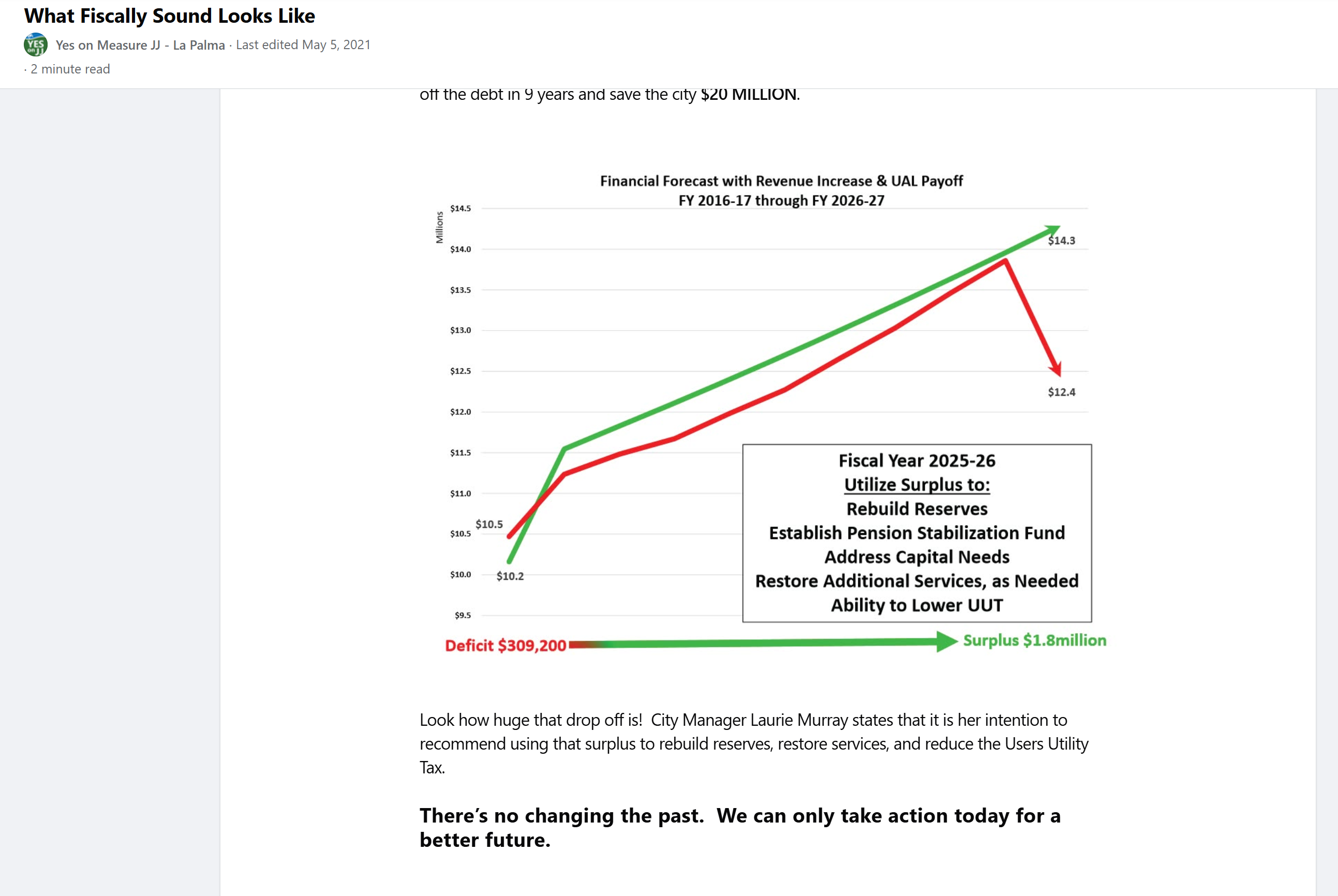
The committee behind the 2016 Yes on Measure JJ campaign published its own financial forecast, titled “What Fiscally Sound Looks Like.” It projected that Measure JJ would reverse a documented $309,200 deficit and produce a $1.8 million surplus by Fiscal Year 2025-26, while increasing the General Fund balance from roughly $10.2 million in FY 2016-17 to $14.3 million by FY 2026-27.
The campaign also made a specific pension promise: “with Measure JJ ending the depletion of reserves, the city has a plan to take that emergency fund, pay off the debt in 9 years and save the city $20 million.” Its forecast identified four uses for the projected FY 2025-26 surplus: rebuilding reserves, establishing a Pension Stabilization Fund, addressing capital needs, and, eventually, lowering the Utility Users Tax.
Nov. 8, 2016
Voters approve Measure JJ by a wide margin: 3,775 in favor (60.34%) to 2,481 opposed (39.66%).
The official argument in favor was signed by Mayor Gerard Goedhart, Mayor Pro Tem Michele Steggell, Council Member Peter Kim, Council Member Steve Shanahan, and former Mayor Mark Waldman — the same five who approved its text at the July 11 special meeting, above.
The official argument against was signed by Keith Nelson, chairman of the Citizen Committee on La Palma's Sustainability and Future and a former mayor, and by Robert Carruth, a member of the same committee and the founder of this site. Their argument labeled the measure a “PENSION TAX,” stated the City had paid over $15,000,000 into pensions in the prior twelve years while still owing $12,381,116 in unfunded liability, and said the council majority had ignored the Citizen Committee's recommendation to evaluate cost-effective police-service alternatives before turning to a tax increase.
Dec. 19, 2019
As shown above, the committee's page names a specific city official as the one committed to acting on the chart's projected surplus: it states that City Manager Laurie Murray intended to recommend directing the FY 2025-26 surplus toward rebuilding reserves, restoring services, and lowering the Utility Users Tax, closing with the line that the past cannot be changed but today's action can build a better future. Murray retired effective December 19, 2019 — see Leadership Transitions — nearly six years before the fiscal year in which the campaign's own chart said she would make that recommendation. The official the campaign named as responsible for delivering the promised surplus left office long before the year the promise came due.
Aug. 5, 2025
A resident asks the council for the current amount of the unfunded pension liability. The Interim City Manager cannot answer.
Then-Mayor Pro Tem Nitesh Patel states from the dais that the liability has “gone down” due to discretionary payments. The City's own audited financial reports show the opposite: the audited GASB Net Pension Liability (NPL) rose from $18.2 million in FY 2016-17 to $23.6 million in FY 2023-24 — a 29.8% increase — while the required annual employer contribution also grew.
No council colleague corrects the record. The nine-year payoff promised to Measure JJ voters would have come due that same year. Neither staff nor the council has ever provided a public accounting of Measure JJ promises versus results.
The trend, charted
CalPERS publishes the underlying employer contribution rates and funding figures every year. The numbers above are not an isolated bad year. They are the two most recent data points in a nine-year trend.
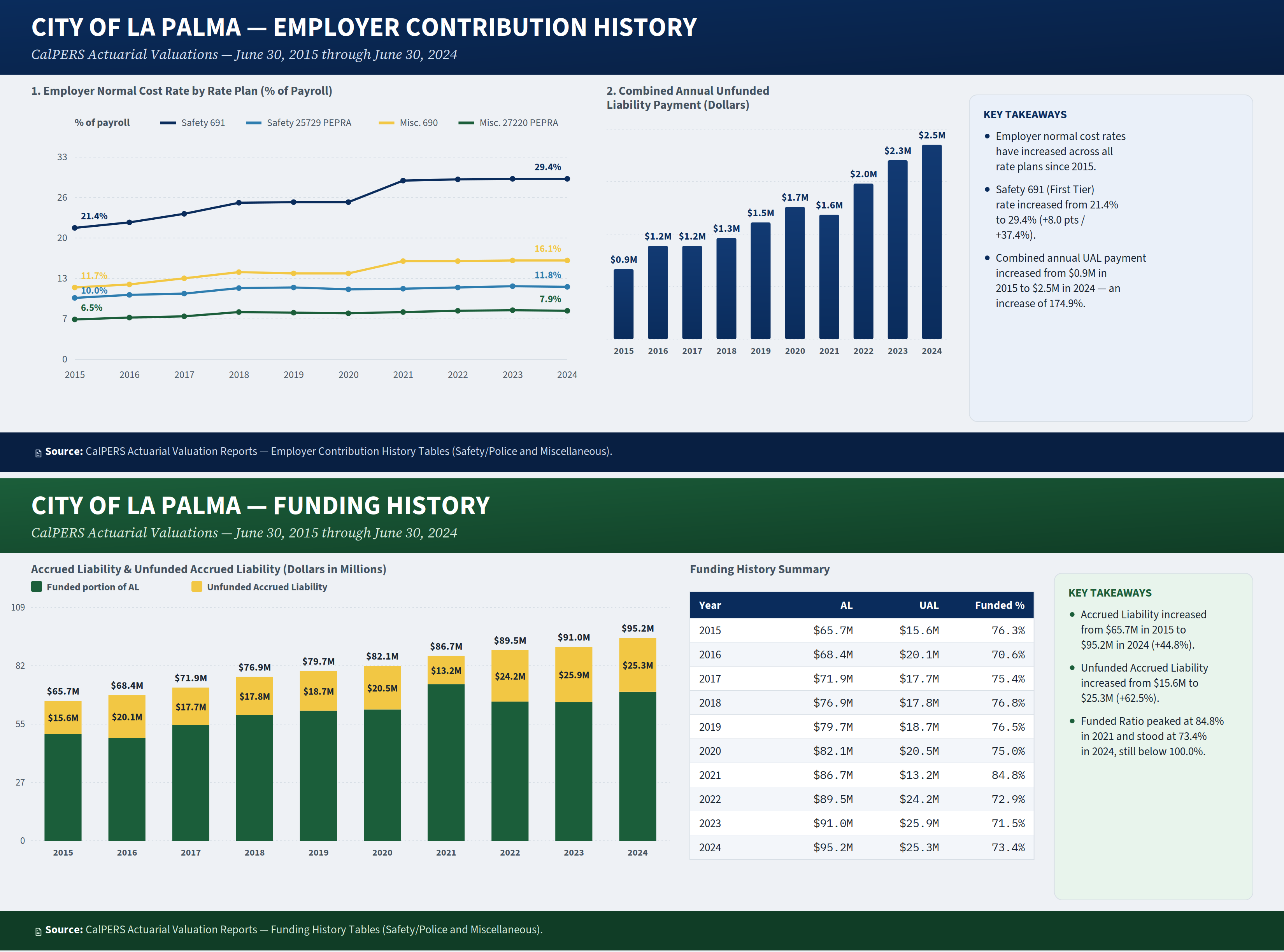
The charts below use CalPERS' own Actuarial Valuation Reports from June 30, 2015 through June 30, 2024. Over that period, the employer normal cost rate increased on all four of the City's rate plans. The largest increase was in the Safety (police) first-tier plan, which climbed from 21.4% of payroll in 2015 to 29.4% in 2024.
The City's annual Unfunded Accrued Liability (UAL) payment rose even more sharply — from $0.9 million to $2.5 million, a 174.9% increase. At the same time, total pension Accrued Liability grew 44.8%, from $65.7 million to $95.2 million. But the Unfunded Accrued Liability grew faster, increasing 62.5% from $15.6 million to $25.3 million.
Nine-year pension payoff not achieved
The most recent CalPERS actuarial valuations for the City's two pension plans — Safety (Police) and Miscellaneous — establish required contributions for Fiscal Year 2026-27. That is immediately after the nine-year period in which the Measure JJ campaign projected the pension debt would be paid off and a surplus realized by FY 2025-26.
These figures use a different accounting basis than the ACFR Net Pension Liability figures above. CalPERS reports funding-basis Unfunded Accrued Liability (UAL) using the market value of plan assets; audited financial statements report pension liability under GASB 68. The two measures are not directly interchangeable and are presented separately here.
According to CalPERS' June 30, 2024 valuations for the City of La Palma (CalPERS ID 3770853942), available through CalPERS' Public Agency Actuarial Valuation Reports lookup:
- Unfunded liability: $25.3 million. The two plans had a combined UAL of $25,322,950 — $15,539,980 for Safety and $9,782,970 for Miscellaneous. The debt was not paid off. It was also higher than the $15,583,758 combined UAL reported in CalPERS' funding-history tables for June 30, 2015.
- Funded ratio: 73.4%. Safety was 71.5% funded and Miscellaneous 75.9%, leaving more than one-quarter of the City's combined pension liability unfunded.
- FY 2026-27 UAL payment: $2.55 million. The required combined UAL payment is $2,545,854. CalPERS projects those payments rising through at least FY 2031-32, reaching approximately $3.0 million.
- Minimum-payment payoff extends to roughly 2040-2041. CalPERS' “Additional Employer Contributions” analysis estimates 15.5 years to pay off the Safety UAL and 14.3 years for Miscellaneous using minimum required payments beginning in FY 2026-27. That puts the projected payoff roughly three decades after Measure JJ passed — not nine years.
- Millions in additional interest remain. The Safety plan's current amortization schedule extends through FY 2043-44 and projects $7,927,851 in remaining interest on that plan's UAL under the existing schedule. Meanwhile, no public accounting demonstrating that the campaign's promised $20 million in savings was actually realized has been identified in the records reviewed for this document.
Promise vs. result
CalPERS' own June 30, 2024 valuation reports a combined unfunded pension liability of $25.3 million.
That outcome differs substantially from the nine-year payoff represented to voters when they approved Measure JJ in 2016.
| Measure JJ Campaign Promise (2016) | Documented Result (CalPERS actuarial valuation, as of June 30, 2024) |
|---|---|
| “Pay off the debt in 9 years” (by FY 2025-26) | Combined UAL $25,322,950 across both plans as of 6/30/2024. CalPERS' current amortization schedule does not project payoff until roughly FY 2040-41 on the Safety plan — about three decades after the vote, not nine years. |
| “Save the city $20 million” | No public accounting of any realized savings has been identified in the records reviewed for this document. CalPERS' current schedule shows $7,927,851 in interest still projected to be paid on the Safety plan's UAL alone. |
| Required annual payment declining as the debt is retired | Combined required UAL payment is $2,545,854 for FY 2026-27. CalPERS projects that payment rising — not falling — to $2,999,000 by FY 2031-32. |
| Reserves rebuilt; Pension Stabilization Fund established; ability to lower the Utility Users Tax (all promised for FY 2025-26) | Not addressed by the CalPERS actuarial data, which covers the pension plans only, not the General Fund. See note below. |
Source documents
Read the primary records yourself
Cited above, at the point in the timeline each supports.
- 📄 CalPERS Actuarial Valuation — Safety Risk Pool, as of June 30, 2024
- 📄 CalPERS Actuarial Valuation — Miscellaneous Risk Pool, as of June 30, 2024
- 📄 CalPERS Public Agency Actuarial Valuation Reports (City of La Palma, ID 3770853942)